AI as a weapon, AI as a target.

An automated watch on attackers using AI and on attacks against AI systems. Short summaries, one click to the source.

42 entries, last updated 21 Sep 2026, 08:44 UTC. Refreshed every six hours.

September 2026

  1. AnthropicVendor report

    Detecting and countering misuse of AI: September 2026 (opens anthropic.com)

    Anthropic describes actors who automate whole intrusion chains with AI agents. One Russian-speaking espionage operator had agents rebuild malware whenever a security product detected it, and used AI to sort hundreds of gigabytes of stolen data.

    Category
    AI-Enabled
    Marker
    Must-read
    Actors
    GTG-20006, Midnight Blizzard
    Attribution
    Russia, per Anthropic (confidence not stated)

July 2026

  1. Elastic Security LabsVendor report

    REF6045: Mexican banking fraud toolkit with signs of AI-assisted development (opens elastic.co)

    Elastic Security Labs documented REF6045, an operator-assisted banking fraud campaign using ClickFix fake-CAPTCHA lures to install a PowerShell toolkit called SCMBANKER against Mexican bank, fintech, and crypto exchange customers. The toolkit enables session monitoring, screenshots, vishing overlays, clipboard hijacking, and RAT deployment, and its scripts show artifacts suggesting an LLM was used to write most of th

    Category
    AI-Enabled
    Malware
    SCMBANKER, Remote Utilities
    Attribution
    not-stated, per Elastic Security Labs (confidence not stated)
  2. FlareVendor report

    Mycelium Framework: First Ever Witnessed AI-as-a-Service Botnet (opens flare.io)

    Flare researchers describe an underground forum advertisement for 'Mycelium Framework,' a botnet claiming to classify infected machines by compute, GPU, stolen AI API keys and local models, then route AI inference, social engineering and other tasks accordingly. No source code or proof of execution was provided, and most individual techniques are previously documented, so the AI-as-a-service claims remain unverified.

    Category
    AI-Enabled
    Malware
    Mycelium Framework, Mirai, TeamTNT, DorkBot, RageBot, Phorpiex, IRCBot.HI
    Vulnerability
    CVE-2021-22205
  3. SysdigVendor report

    JADEPUFFER: Agentic ransomware for automated database extortion (opens sysdig.com)

    Sysdig's Threat Research Team documented what they assess to be the first fully agentic ransomware operation, dubbed JADEPUFFER, where an LLM autonomously gained access via a Langflow RCE flaw, harvested credentials, exploited Nacos authentication bypasses, and encrypted and destroyed a victim's production database for extortion. The payloads showed self-narrating reasoning and adaptive retries with no human interven

    Category
    AI-Enabled
    Actor
    JADEPUFFER
    Malware
    JADEPUFFER
    Vulnerabilities
    CVE-2025-3248, CVE-2021-29441

June 2026

  1. FortiGuard LabsVendor report

    Threat Actors Weaponize AI Hype to Deliver AsyncRAT (opens fortinet.com)

    FortiGuard Labs documented a multi-stage Windows malware campaign using fake AI-themed documents and guides as lures to deliver AsyncRAT via AutoHotkey-based loaders and process hollowing. Chinese-language code artifacts and structured coding style suggest the attackers used generative AI tools to help build the malware, though this is inferred rather than confirmed.

    Category
    AI-Enabled
    Malware
    AsyncRAT, AutoHotkey, clay_Client
  2. Help Net SecurityNews

    Prompt injection still drives most agentic AI security failures in production (opens helpnetsecurity.com)

    Coverage of OWASP's 2026 findings on agentic AI. Most production failures still begin with prompt injection, and attackers increasingly poison what agents trust: MCP servers, packages and coding-tool configuration.

    Category
    AI-Targeted
    Vulnerabilities
    CVE-2025-6514, CVE-2026-22708
  3. AnthropicVendor report

    What we learned mapping a year's worth of AI-enabled cyber threats (opens anthropic.com)

    Anthropic analyzed 832 accounts banned for malicious cyber activity between March 2025 and March 2026, mapping their techniques to MITRE ATT&CK. They found AI use shifting from initial access to post-compromise activity, risk scores rising over time, and the framework failing to capture autonomous agentic orchestration seen in a November 2025 state-sponsored espionage case.

    Category
    AI-Enabled
    Malware
    Claude Code

May 2026

  1. Trend MicroVendor report

    Inside SHADOW-WATER-063’s Banana RAT: From Build Server to Banking Fraud (opens trendmicro.com)

    Trend Micro's MDR team correlated attacker server infrastructure with victim telemetry to map Banana RAT, a banking trojan targeting 16 Brazilian financial institutions via phishing and fileless PowerShell delivery. The malware provides remote control, keylogging, overlay injection, and PIX QR code interception, using a polymorphic crypter service to evade detection.

    Category
    AI-Targeted
    Actor
    SHADOW-WATER-063
    Malware
    Banana RAT, Backdoor.PS1.BANANARAT.A
    Attribution
    Brazil, per TrendAI (high confidence)

    Also covered byZscaler ThreatLabz

  2. Google Threat Intelligence GroupVendor report

    GTIG AI Threat Tracker: Adversaries Leverage AI for Vulnerability Exploitation, Augmented Operations, and Initial Access (opens cloud.google.com)

    GTIG reports adversaries applying AI to vulnerability exploitation, initial access and faster development of evasive, polymorphic malware. It also covers supply chain attacks against AI components, and notes no actor has yet bypassed the core safety logic of frontier models.

    Category
    AI-Enabled
    Marker
    Must-read
  3. Trend MicroVendor report

    Vibe Hacking: Two AI-Augmented Campaigns Target Government and Financial Sectors in Latin America (opens trendmicro.com)

    Trend Micro identified two campaigns, SHADOW-AETHER-040 and SHADOW-AETHER-064, using agentic AI (including Claude) to drive intrusions from initial access to data exfiltration against government and financial targets in Mexico and Brazil. The AI agents dynamically generated custom tools and backdoors, used jailbreaking via fake red-team pretexts, and integrated with Shodan and VulDB for reconnaissance.

    Category
    AI-Enabled
    Actors
    SHADOW-AETHER-040, SHADOW-AETHER-064
    Malware
    Chisel, Neo-reGeorg, CrackMapExec, Impacket, implante_http, ProxyChains, PetitPotam
  4. Microsoft SecurityResearch

    When prompts become shells: RCE vulnerabilities in AI agent frameworks (opens microsoft.com)

    Microsoft researchers show how a single injected prompt reached host-level code execution in agents built on Semantic Kernel. Model-controlled parameters flowed unsanitized into a search plugin. Both flaws are fixed.

    Category
    AI-Targeted
    Vulnerabilities
    CVE-2026-25592, CVE-2026-26030

April 2026

  1. OWASP GenAI Security ProjectResearch

    OWASP GenAI Exploit Round-up Report Q1 2026 (opens genai.owasp.org)

    Quarterly review of eight AI-related incidents mapped to the OWASP LLM and agentic risk lists. It includes active exploitation of a maximum-severity Flowise flaw and GrafanaGhost, a prompt injection path that exfiltrates data from Grafana's AI features.

    Category
    AI-Targeted
    Vulnerability
    CVE-2025-59528
  2. Gambit SecurityVendor report

    A Single Operator, Two AI Platforms, Nine Government Agencies: The Full Technical Report (opens gambit.security)

    Gambit Security's forensic report describes a single operator who used Claude Code and OpenAI's GPT-4.1 as core operational tools to breach nine Mexican government organizations and exfiltrate hundreds of millions of records between December 2025 and February 2026. Recovered materials show over 400 custom attack scripts, 20 tailored exploits, and thousands of AI-generated commands used to compress attack timelines an

    Category
    AI-Enabled
    Attribution
    Mexico, per Gambit Security (confidence not stated)

March 2026

  1. Datadog Security LabsResearch

    LiteLLM and Telnyx compromised on PyPI: Tracing the TeamPCP supply chain campaign (opens securitylabs.datadoghq.com)

    Two backdoored releases of LiteLLM, a widely used LLM gateway library, were published to PyPI on March 24, 2026 with a credential stealer. Datadog traces the campaign from a poisoned Trivy scanner through npm and into PyPI.

    Category
    AI-Targeted
    Actor
    TeamPCP

    Also covered byLiteLLM

  2. IBM X-ForceVendor report

    A Slopoly start to AI-enhanced ransomware attacks (opens ibm.com)

    IBM X-Force found a likely AI-generated PowerShell C2 backdoor, dubbed Slopoly, deployed by ransomware group Hive0163 during a live intrusion using ClickFix, NodeSnake, InterlockRAT and Interlock ransomware. The malware is technically unremarkable but shows guardrail bypass and signals adoption of AI-assisted malware development among established ransomware actors.

    Category
    AI-Enabled
    Actors
    Hive0163, ITG23, TA569, TAG-124
    Malware
    Slopoly, NodeSnake, InterlockRAT, Interlock, JunkFiction, Broomstick, Supper, PortStarter

February 2026

  1. OpenAIVendor report

    Disrupting malicious uses of AI (opens openai.com)

    OpenAI's case studies show models used as one step in larger workflows that also rely on websites and social accounts: romance and recovery scams, covert influence operations, and a state-linked harassment effort.

    Category
    AI-Enabled
    Marker
    Must-read
    Actor
    Rybar

    Also covered byHelp Net Security

  2. TrendAI ResearchVendor report

    Malicious OpenClaw Skills Used to Distribute Atomic macOS Stealer (opens trendaisecurity.com)

    TrendAI Research documented a campaign where malicious OpenClaw agent skills trick AI agents like GPT-4o into installing a new variant of Atomic macOS Stealer (AMOS), which then deceives users into entering their password. The malware exfiltrates browser data, crypto wallets, Apple and KeePass keychains, and documents, with hundreds of malicious skills found across ClawHub, SkillsMP, and GitHub repositories.

    Category
    AI-Targeted
    Malware
    Atomic (AMOS) Stealer, AMOS
  3. Hunt.io / cyberandramen.netResearch

    LLMs in the Kill Chain: Inside a Custom MCP Targeting FortiGate Devices Across Continents (opens cyberandramen.net)

    Researchers found an exposed server revealing a threat actor using a custom MCP server (ARXON) with DeepSeek and Claude Code to automate reconnaissance, attack planning, and exploitation of compromised FortiGate devices across thousands of targets in over 100 countries. The actor evolved from using open-source HexStrike MCP tooling in December 2025 to fully custom orchestration (ARXON and CHECKER2) by February 2026,

    Category
    AI-Enabled
    Malware
    ARXON, CHECKER2, HexStrike, ntlmrelayx.py, Impacket, Metasploit, BloodHound, Nuclei
    Vulnerabilities
    CVE-2019-6693, CVE-2026-24061, CVE-2025-33073, CVE-2023-27532, CVE-2019-7192
  4. Amazon Threat IntelligenceVendor report

    AI-augmented threat actor accesses FortiGate devices at scale (opens aws.amazon.com)

    Amazon Threat Intelligence documented a Russian-speaking, financially motivated actor using multiple commercial LLMs to compromise over 600 FortiGate devices in 55+ countries via exposed management interfaces and weak credentials, not exploits. AI generated attack plans, custom Go/Python tooling, and reconnaissance scripts, letting a low-skill actor achieve broad operational scale, though it still failed against hard

    Category
    AI-Enabled
    Actor
    Ed1s0nZ
    Malware
    Meterpreter, mimikatz, gogo, Nuclei, CyberStrikeAI, PrivHunterAI, InfiltrateX, watermark-tool
    Vulnerabilities
    CVE-2019-7192, CVE-2023-27532, CVE-2024-40711

    Also covered byTeam Cymru

  5. ESET ResearchVendor report

    PromptSpy ushers in the era of Android threats using GenAI (opens welivesecurity.com)

    ESET found PromptSpy, Android malware that queries Google's Gemini with UI XML dumps to get step-by-step instructions for locking itself into the recent apps list, aiding persistence. The malware also deploys a VNC module for remote device control and targets users in Argentina; no live samples have been seen in telemetry, suggesting it may still be a proof of concept.

    Category
    AI-Enabled
    Malware
    PromptSpy, VNCSpy, PromptLock, Android.Phantom, Android/Phishing.Agent.M
    Attribution
    China, per ESET (medium confidence)
  6. Google Threat Intelligence GroupVendor report

    GTIG AI Threat Tracker: Distillation, Experimentation, and (Continued) Integration of AI for Adversarial Use (opens cloud.google.com)

    Quarterly view of how actors linked to North Korea, Iran, China and Russia used AI in late 2025. GTIG saw no breakthrough capability, but disrupted frequent model extraction attempts against its own models.

    Category
    AI-Enabled
    Marker
    Must-read
    Attribution
    North Korea, Iran, China, Russia, per Google Threat Intelligence Group (confidence not stated)

    Also covered byGoogle

  7. Moonlock LabVendor report

    Moonlock Lab thread on ClickFix malware abusing Claude.ai and Medium (opens x.com)

    Moonlock Lab reports that a Google Sponsored ad for a macOS search led users to malware via ClickFix delivery, seen over 15,000 times. One variant abused a public artifact hosted on claude.ai, while another used a Medium post impersonating Apple support, both attributed to the same threat actor.

    Category
    AI-Targeted
    Malware
    ClickFix

January 2026

  1. Breached.companyNews

    The Lethal Trifecta Strikes: Four Major AI Agent Vulnerabilities in Five Days (opens breached.company)

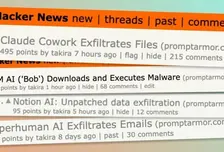
    Between January 7-15, 2026, researchers including PromptArmor disclosed indirect prompt injection vulnerabilities in four production AI tools: IBM Bob, Superhuman AI, Notion AI, and Anthropic's Claude Cowork, each allowing data exfiltration via the 'lethal trifecta' of private data access, untrusted content exposure, and external communication channels. Vendor responses varied widely, from Superhuman's rapid remediat

    Category
    AI-Targeted
    Malware
    Claude Cowork, IBM Bob, Notion AI, Superhuman AI, Superhuman Go

December 2025

  1. Unit 42 (Palo Alto Networks)Vendor report

    New Prompt Injection Attack Vectors Through MCP Sampling (opens unit42.paloaltonetworks.com)

    Unit 42 researchers show that the Model Context Protocol sampling feature, which lets MCP servers request LLM completions from the client, lacks security controls and trusts servers implicitly. They built a proof-of-concept malicious MCP server against an unnamed coding copilot demonstrating resource theft via hidden prompts, conversation hijacking, and covert tool invocation. No in-the-wild exploitation is claimed;

    Category
    AI-Targeted

November 2025

  1. AnthropicVendor report

    Disrupting the first reported AI-orchestrated cyber espionage campaign (opens anthropic.com)

    A group tasked Claude Code with running intrusions against roughly 30 organisations, with the model carrying out an estimated 80 to 90 percent of tactical work. Anthropic validated a handful of successful compromises before banning the accounts.

    Category
    AI-Enabled
    Marker
    Must-read
    Actor
    GTG-1002
    Attribution
    China, per Anthropic (high confidence)
  2. Google Threat Intelligence GroupVendor report

    GTIG AI Threat Tracker: Advances in Threat Actor Usage of AI Tools (opens cloud.google.com)

    GTIG documents the first malware families that query an LLM during execution to generate scripts and rewrite their own code. It also describes actors posing as students or researchers to talk Gemini past its safeguards.

    Category
    AI-Enabled
    Marker
    Must-read
    Actor
    APT28
    Malware
    PROMPTFLUX, PROMPTSTEAL
  3. Infosecurity MagazineNews

    Claude Desktop Extensions Vulnerable to Web-Based Prompt Injection (opens infosecurity-magazine.com)

    Researchers reported that extensions for the Claude desktop app could be driven by instructions planted in web content, turning an ordinary browsing request into a path to actions on the user's machine.

    Category
    AI-Targeted

October 2025

  1. OpenAIVendor report

    Disrupting malicious uses of AI: October 2025 (opens openai.com)

    OpenAI details banned accounts tied to state actors and criminal groups that used ChatGPT for malware development, scams and surveillance tooling. It reports no evidence that its models gave attackers novel offensive capability.

    Category
    AI-Enabled

    Also covered byIT Brew

September 2025

  1. Koi SecurityResearch

    First Malicious MCP in the Wild: The Postmark Backdoor That's Stealing Your Emails (opens koi.ai)

    An npm package posing as the Postmark MCP server behaved normally for fifteen versions, then added one line that copied every email sent through it to the author's server. Koi calls it the first malicious MCP server seen in the wild.

    Category
    AI-Targeted

    Also covered byThe Hacker NewsDark Reading

  2. DataconomyNews

    SentinelOne finds MalTerminal malware using OpenAI GPT-4 (opens dataconomy.com)

    SentinelLABS hunted for binaries carrying LLM API keys and embedded prompts, and found MalTerminal, which asks GPT-4 to write ransomware or a reverse shell at runtime. A retired API endpoint dates it before November 2023. No live use is known.

    Category
    AI-Enabled
    Malware
    MalTerminal

August 2025

  1. AnthropicVendor report

    Threat Intelligence Report: August 2025 (opens anthropic.com)

    Introduces vibe hacking: one criminal used Claude Code to run data extortion against at least 17 organisations. Other cases cover North Korean remote worker fraud, ransomware sold by a developer with little coding skill, and AI across the fraud ecosystem.

    Category
    AI-Enabled
    Marker
    Must-read
    Actor
    North Korean IT workers
    Malware
    Claude Code, Claude
    Attribution
    North Korea, China, per Anthropic (confidence not stated)

    Also covered byAnthropic

  2. ESET ResearchResearch

    First known AI-powered ransomware uncovered by ESET Research (opens welivesecurity.com)

    PromptLock runs OpenAI's gpt-oss-20b locally through Ollama to generate Lua scripts that enumerate, exfiltrate and encrypt files. ESET later confirmed the samples match an academic prototype, not malware deployed in attacks.

    Category
    AI-Enabled
    Malware
    PromptLock
  3. The Hacker NewsNews

    Cursor AI Code Editor Fixed Flaw Allowing Attackers to Run Commands via Prompt Injection (opens thehackernews.com)

    An indirect prompt injection could make Cursor's agent write a malicious MCP configuration file without user approval, giving the attacker remote code execution on the developer's machine.

    Category
    AI-Targeted
    Vulnerability
    CVE-2025-54135

July 2025

  1. The Hacker NewsNews

    CERT-UA Discovers LAMEHUG Malware Linked to APT28, Using LLM for Phishing Campaign (opens thehackernews.com)

    LAMEHUG, delivered by phishing to Ukrainian government bodies, sends task descriptions to a Qwen model hosted on Hugging Face and runs the Windows commands it returns.

    Category
    AI-Enabled
    Actors
    APT28, UAC-0001
    Malware
    LAMEHUG
    Attribution
    Russia, per CERT-UA (medium confidence)

June 2025

  1. SecurityWeekNews

    'EchoLeak' AI Attack Enabled Theft of Sensitive Data via Microsoft 365 Copilot (opens securityweek.com)

    Aim Security showed that a single crafted email could make Microsoft 365 Copilot send internal data to an attacker with no user interaction. Microsoft patched it server-side and reported no exploitation in the wild.

    Category
    AI-Targeted
    Vulnerability
    CVE-2025-32711

    Also covered byarXiv

April 2025

  1. AnthropicVendor report

    Operating Multi-Client Influence Networks Across Platforms (opens cdn.sanity.io)

    Anthropic disrupted an influence-as-a-service operation that used Claude to manage over 100 social media personas across X and Facebook, making tactical decisions on engagement and generating image prompts. The operation served at least four distinct clients pushing narratives on European, Iranian, UAE, and Kenyan interests, prioritizing persistence and relationship-building over viral spread. No nation-state attribu

    Category
    AI-Enabled
    Malware
    Claude

    Also covered byAnthropic

January 2025

  1. Google DeepMindVendor report

    How we estimate the risk from prompt injection attacks on AI systems (opens blog.google)

    Google DeepMind describes an automated red-teaming framework using optimization-based attacks (Actor Critic, Beam Search, Tree of Attacks with Pruning) to test AI agents' susceptibility to indirect prompt injection that could exfiltrate sensitive user data. This is a defensive research methodology, not a report of real-world exploitation, and no specific incidents are disclosed.

    Category
    AI-Targeted
  2. Google Threat Intelligence GroupVendor report

    Adversarial Misuse of Generative AI (opens cloud.google.com)

    GTIG's first analysis of how government-backed groups used Gemini. Actors from Iran, China, North Korea and Russia used it for research, coding help and content, and did not develop novel capabilities with it.

    Category
    AI-Enabled
    Marker
    Must-read
    Actor
    APT43
    Attribution
    Iran, China, North Korea, Russia, per Google Threat Intelligence Group (confidence not stated)

    Also covered byTechTarget

  3. Wiz ResearchResearch

    Wiz Research Uncovers Exposed DeepSeek Database Leaking Sensitive Information, Including Chat History (opens wiz.io)

    An unauthenticated ClickHouse database belonging to DeepSeek exposed over a million log lines, including chat history, API secrets and backend details, and allowed full control of the database. DeepSeek secured it after disclosure.

    Category
    AI-Targeted

June 2024

  1. Google Threat Analysis GroupVendor report

    Google disrupted over 10,000 instances of DRAGONBRIDGE activity in Q1 2024 (opens blog.google)

    Google's TAG reports on DRAGONBRIDGE, a PRC-linked influence operation, disrupting over 10,000 instances in Q1 2024 across YouTube and Blogger, totaling 175,000 lifetime. The actor increasingly used generative AI, including AI-generated news anchors and synthetic voiceovers, to push narratives around Taiwan's election and US social issues, though engagement remained largely inauthentic and low.

    Category
    AI-Enabled
    Actor
    DRAGONBRIDGE
    Attribution
    China, per Google Threat Analysis Group (high confidence)

May 2024

  1. OpenAIVendor report

    AI and Covert Influence Operations: Latest Trends (opens cdn.openai.com)

    OpenAI describes disrupting five covert influence operations from Russia, China, Iran and an Israeli commercial firm that used its models to generate and refine content, translate text, and fake engagement across social platforms. None of the operations achieved meaningful audience engagement, scoring no higher than Category 2 on the Breakout Scale.

    Category
    AI-Enabled
    Actors
    Bad Grammar, Doppelganger, Spamouflage, International Union of Virtual Media (IUVM), Zero Zeno, STOIC
    Attribution
    Russia, China, Iran, Israel, per OpenAI (confidence not stated)

    Also covered byOpenAI

February 2024

  1. Microsoft Threat IntelligenceVendor report

    Staying ahead of threat actors in the age of AI (opens microsoft.com)

    Microsoft and OpenAI published the first joint account of state-affiliated groups using LLMs, mostly for reconnaissance, scripting help and social engineering content. The accounts were disabled.

    Category
    AI-Enabled
    Marker
    Must-read
    Actors
    Forest Blizzard, Emerald Sleet, Crimson Sandstorm, Charcoal Typhoon, Salmon Typhoon
    Attribution
    Russia, North Korea, Iran, China, per Microsoft (confidence not stated)

    Also covered byOpenAI